Updated: October 2026 · e-land editorial team
Disclaimer: The information in this article is general, correct as of the update date, and does not constitute legal or tax advice. Every project is different, and before signing you should consult an attorney who specializes in urban renewal.
A developer knocked on the door, a neighbor says he has already signed, and the building's WhatsApp group talks only about a new apartment with a safe room and parking. Pinui Binui (evacuation and reconstruction) can be the most profitable deal of your life, but it is also a long and complex process. In this guide we explain what you are entitled to, what the law says and what you must check before signing.
What is Pinui Binui?
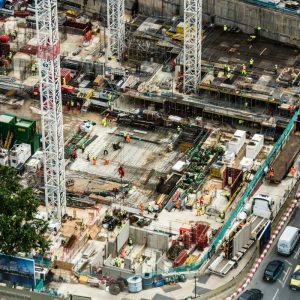
Pinui Binui is an urban renewal track in which an old building, or a compound of old buildings, is demolished and replaced with new buildings that are taller and contain more apartments.
The deal itself is simple: the apartment owners "sell" the developer their old apartment and their building rights, and in return receive a new apartment in the building to be constructed. The developer finances the project by selling the additional apartments to new buyers.
The main law in this field is the Evacuation and Reconstruction (Encouragement of Evacuation and Reconstruction Projects) Law, 5766-2006, which has been amended several times in recent years.
What do owners usually receive?
No law sets exactly how many square meters each resident receives. The consideration is determined by negotiation and depends on the project's economic feasibility. A customary consideration package usually includes:
-
A new apartment larger than the old one.
-
A safe room (mamad), a balcony, parking and usually a storage room.
-
Rent for the entire construction period, and moving expenses.
-
An attorney, appraiser and engineering supervisor on behalf of the residents, whose fees are usually paid by the developer.
-
Bank guarantees that secure the apartment owners throughout the project.
An important principle worth anchoring in the contract: owners of similar apartments receive similar consideration.
How many apartment owners must agree?
Ultimately, demolition and reconstruction require all apartment owners. However, the law allows a certain majority (a "special majority") to act against those who refuse unreasonably. Since an amendment approved in 2021, the required majority in a compound is:
-
Two-thirds of all apartments in the compound (previously 80%), and in addition:
-
At least 60% of the apartments in each building in the compound separately, and
-
More than half of the common property in each building is attached to the apartments of the consenting owners.
Apartment owners who committed building violations or trespassed on the property may not be counted.
What happens with a "refusing tenant"?
A refusing tenant (dayar sarvan) is an apartment owner who refuses the deal without reasonable cause, or sets conditions different from those of the neighbors. When there is a special majority, a claim can be filed against him, and the court may order him to compensate the neighbors for the damage he caused, and may even authorize someone to sign in his place. The Governmental Authority for Urban Renewal also handles such disputes.
Important to know:
Not every refusal is unreasonable. An owner who points to a real problem in the contract, the developer or the security arrangements may actually be the one protecting everyone.
Special protection for elderly apartment owners
The law defines an "elderly person" as an apartment owner who was at least 70 years old when the first agreement in the building was signed, and who has lived in the apartment for at least two years. Such owners are entitled to special alternatives (for example, a ready apartment outside the compound or a move to assisted living), and if no suitable alternative was offered to them, refusing-tenant proceedings cannot be taken against them. The Real Estate Taxation Law was amended so that these alternatives also enjoy tax exemptions.
Taxation
Good news for apartment owners:
For the Israel Tax Authority, Pinui Binui is a sale of the old apartment. The law grants several important reliefs:
-
Exemption from capital gains tax (mas shevach) on receiving the new apartment, under the conditions set by law. This exemption is in addition to other exemptions, and using it does not "use up" the single-apartment exemption.
-
The rent paid by the developer during construction is not considered taxable income, according to the Tax Authority's position, even if the old apartment was rented out.
-
During construction, the right to the new apartment is considered a "residential apartment" for capital gains tax and purchase tax purposes, so those who sell or buy another apartment during this period are not adversely affected.
-
Heirs who received an apartment included in the project may, under certain conditions, retain the inheritance exemption when selling the replacement apartment as well.
The organizer
Who is it and what is permitted:
Sometimes the first to arrive at the building is not a developer but an "organizer" who signs up the residents and sells the project onward. The Organizers Law of 2017 (the Urban Renewal (Agreements for Organizing Transactions) Law) was designed to prevent situations in which residents remain bound for years to someone who is not advancing the project. The law limits the validity period of such an agreement and requires the deal to be presented at a meeting of the apartment owners.
Recommendation:
Before signing any document, even a "mere agreement in principle", find out exactly what it obliges you to do and for how long.
How long does it take?
A Pinui Binui project goes through several stages: organizing the residents and choosing a developer, signing an agreement, plan approval, a building permit, evacuation, demolition and construction. In practice this usually takes many years from the first signature to receiving the keys. To protect residents, the law provides that a deal that has not progressed sufficiently within defined periods may lapse – for example, if the developer has not signed up half of the apartment owners within two years, or 60% within four years.
Checklist
What to check before signing:
-
Who is the developer? Projects completed, financial strength, and whether it builds itself or only signs up residents in order to sell the project.
-
An attorney acting for the residents only, chosen by you and not by the developer, even if the developer pays the fees.
-
Guarantees: a Sale Law guarantee, a rent guarantee, and a guarantee covering the taxes.
-
The technical specification and the plan of the new apartment attached to the agreement.
-
Timetables and compensation for delay, written explicitly.
-
Equality among residents: no "side agreements" with any particular resident.
-
The model agreement of the Governmental Authority for Urban Renewal can serve as a benchmark for reviewing the contract.
The bottom line
Pinui Binui has become the main urban renewal track in Israel. Apartment owners who organize early, choose independent legal representation and insist on security arrangements end up with a new, protected asset worth much more than the old apartment.
Disclaimer: The information in this article is general, correct as of the update date, and does not constitute legal or tax advice. Every project is different, and before signing you should consult an attorney who specializes in urban renewal.
Sources
-
Evacuation and Reconstruction (Encouragement of Evacuation and Reconstruction Projects) Law, 5766-2006 (Nevo): Link (in Hebrew)
-
Amir Klausner Law Office, "The majority required to carry out the project": Link (in Hebrew)
-
Nadlan Center, "Pinui Binui Law – the complete guide for 2026": Link (in Hebrew)
-
Kol Zchut, "Capital gains tax exemption in Pinui Binui": Link (in Hebrew)
-
Globes, on the rent exemption during the evacuation period: Link (in Hebrew)
-
Nadlan Center, on the inheritance exemption for a replacement apartment: Link (in Hebrew)
-
HaSulam (Globes), rights of the elderly in urban renewal: Link (in Hebrew)
-
Nadlan Center, "The Organizers Law – the complete guide for 2026": Link (in Hebrew)